Infrastructure
Data compiled by anyone. Valuable to everyone.
A shared framework that lets local witnesses turn what they know into a structured, reusable and exchangeable resource, and connects them to a global demand for trustworthy local data.


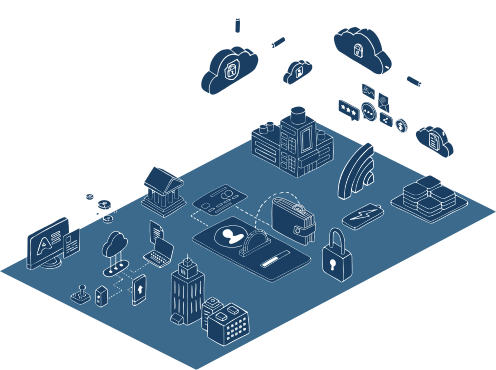


More than software
Software that understands the context it serves.
Building for people who solve problems in the field is hard in ways office software never has to face. The framework is shaped around four hard facts of that context.
Priorities change fast
What mattered when a programme was designed is rarely what matters by its second year. Systems assemble from modular building blocks, so they reconfigure when the mandate moves instead of being rebuilt.
Funding cycles are short
A system has to exist, work and prove itself within one grant, not after a multi-year IT project. Configuration rather than custom code stands a working system up in weeks, and it scales when the work does.
Many parties, many permissions
One system may serve a cooperative, a bank, a donor, an auditor and a ministry at once, each with different roles, views and rights. Permission types, roles and interfaces are first-class parts of the framework, not afterthoughts.
Utility for every party
People stop recording the moment a system serves someone else's report instead of their own work. Every party gets something useful from day one, so the data stays alive.
Where the knowledge lives
From the field

- Forms
- Mobile tools
- Voice
From the files

- Documents
- Photos
- Archives
From other systems
- Sensors
- Satellites
- Other software
One shared engine
Ingest
Take in existing information from wherever it already lives: documents, photos, archives, sensors, satellite imagery, databases and other systems.
Compile
Guide users through creating new structured records from daily work: forms, mobile tools, voice notes and step-by-step workflows in their own language.
Analyse
Score, flag, and visualise, with dashboards and compliance views built in.
Connect
Open secure, permissioned access so clients and partners can reuse structured data, build on it, or exchange it under granular sharing rules.
The apps
Public apps, collaborative apps, private apps, SaaS products: governance varies, the engine does not.
Because the hard part, capturing, structuring and safely reusing data that was never digital, is shared across every app, building a new one is fast, and every improvement reaches all of them.
See it happen
A paragraph becomes a hundred data points.
A field note, the way it is actually written. Watch what the system does with it.
Visited the site by the river on Tuesday. Spoke with the cooperative's treasurer. Two pumps broken since March; the eastern pit flooded. About forty workers on day shift. The buyer from town came twice last week.
The record
- Place
- the site by the river
- Date
- Tuesday
- Person
- the cooperative's treasurer
- Equipment
- Two pumps broken since March
- Incident
- the eastern pit flooded
- Workforce
- forty workers
- Trade contact
- The buyer from town came twice
This is what "structure turns opinion into fact" looks like. Every phrase becomes a field another system, and another reader, can use.
Connected layer
AvailableEcosystem benefits, without dependency.
Beyond the client-owned system, Datastake apps can connect to optional ecosystem services: exchange, integrations, public-source hubs and agentic workflows that help systems expand. Some are operated with DAAC. They add ecosystem value around an app; they are not the app itself, and the system runs without them.
The build model
Built by agents, designed by people.
The framework is driven by configuration rather than code, which makes it unusually well suited to AI. Datastake designs the system, defines the rules, and uses agentic workflows to configure, deploy and expand it under human supervision. The result is not autonomous software for its own sake. It is a way to build and maintain secure, fully customisable and interoperable infrastructure for organisations that need software but are not software companies.
Data exchange between systems
Structured data moves between participating systems under each owner's sharing rules.
Public-source knowledge
Consolidated public sources can support the daily work inside an app and help new digital tools spread through an ecosystem.
Other integrations
Purpose-built connections between your system and the services around it.
Agentic system expansion
Agentic workflows help deploy, manage and expand systems at AI pace, with people designing and checking the work.
Discoverability Built in
Make datasets, records, tools or evidence findable by sector, geography, type and provenance without exposing what should stay private.
Granular sharing Built in
Share a field, a document, a score, a view or a full export under explicit access settings chosen by the owner.
Custody and recyclability Built in
Keep a record of who accessed what, when and why, so data collected once for one objective can be reused responsibly toward the next.
The boundary matters. Your application, configuration and data are the infrastructure you own. Connected services can add reach, integrations and ecosystem knowledge, but they never become a dependency that locks you in.
What every system ships with
Not promises. Shipped, in systems running today.
Every Datastake system assembles from capabilities already proven in the field. These are the ones buyers ask about once they see them.
Transparent scoring
Explainable 0 to 100 scores: every score traceable to the data points behind it, never a black box.
WAZI · KOTAMulti-source verification
Information is consolidated across sources; corroborated data carries more weight, so honesty is structurally rewarded.
Framework-wideAlways-current assessments
Scores recalculate the moment data changes, a document expires, or evidence lands, with prioritised next steps.
Framework-wideProvenance that survives sharing
Source attribution follows every record through every reshare, with notifications and granular partner channels.
Nashiriki · WAZIOnboarding for low-digital counterparties
Staff can run the entire flow on behalf of someone without a smartphone, producing identical, first-class data.
KOTALeave-anytime exports
Open-format exports with schema, version history and audit trail, runnable whenever you choose. Contractual, not courtesy.
Every contractMulti-language and jurisdiction packs
Interfaces in your users’ languages, with country-specific documents, currency and screening scope.
KOTA (French) · WAZI (building Kiswahili, Spanish)Whole-network risk profiles
Assess a web of actors and sites as one object: supply profiles, ownership traversal, map views.
WAZI · Oreka
Ownership
You own it.
- Your data, exportable any timeIn open formats, with its full structure and history.
- Your system, maintained with youDatastake can keep it running, improving and expanding, because most partners need software without becoming software companies.
- Run independently if you need toThe knowledge and, under defined conditions, the code, are yours, so continuity never depends on lock-in.
- No cliff edgeIf Datastake were no longer in the loop, your data, configuration and recovery path remain yours.
Who it serves
Built for the people who need evidence, not estimates.
NGOs
Coordinate across development actors and let target communities evaluate impact themselves.
Build on the framework
Bring a workflow that should be digital, and get back a system you own.
Collaborate